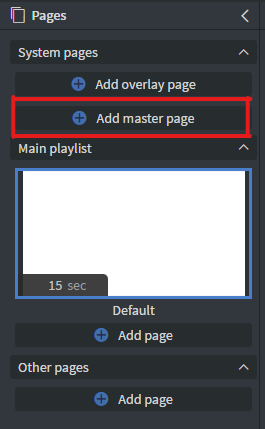
Pages Sidebar
In Content Designer, the Pages sidebar on the left groups pages into System pages, the Main playlist, and Other pages. You can add pages here and arrange their playback order.
System pages
System pages place elements over or behind the other pages in a content. You can edit them like regular pages, but Master and Overlay pages are not designed to manage, activate, or initiate sensor events.
Overlay page
Use Add overlay page to place widgets over every page of the content. Every element on the Overlay page appears above the other pages, and you can edit it like a regular page.

Master page
A Master page puts elements behind every page of a content. For example, you can set a background image once instead of adding it to each page. Use Add master page to create one in this content's page list; it belongs to this content and can be edited like a regular page.
You can also select a Content, Loop, or Schedule as the Master page under Content properties. That source cannot be edited from inside the current content.

Main playlist
The Default page starts as the first page of the content. You can move it and remove its original layers. Use Add page to create more pages, then drag pages into the desired playback order. You can also choose an animation for transitions between pages.

Other pages
Pages created in Other pages start outside the Main playlist. Drag a page into the Main playlist to include it in the regular playback order. You can set how long it appears and use Dynamic pages in its page properties to control page order.

Content page actions
Each page card in the Pages sidebar exposes its own controls. Hover the card to reveal them.
Rename page
The page name on the card is editable in place: select it and type a new name. Naming pages is worth doing when a content has several similar pages, because the cards are otherwise told apart only by their thumbnail.
Page duration
The card shows how long the page plays, in seconds, with a stepper to raise or lower it. Two pages behave differently and say so on the card:
- A page whose duration is dynamic follows the widget selected in its settings.
- A page holding inserted content plays for that content's own duration.
To set duration from the properties panel instead, or to control what happens when a widget finishes, see Dynamic Pages.
Duplicate page
Creates a copy of the page in the same content straight away, and opens the copy. Use it to build a second page from one you have already laid out, or to recover a layout you deleted by mistake — duplicate a page that still has the arrangement you want, then swap its sources.
Copy page
Copies the page to a clipboard rather than creating anything. A Paste control then appears, so you can place the page where you want it — including in a different content, as long as you stay in the same browser session.
Duplicate makes the copy here and now, in this content. Copy picks the page up so you can paste it somewhere else. Reach for Duplicate when you want another page like this one, and Copy when the page needs to end up in a different content.
Toggle overlay preview
Plays the content's Overlay page on top of the selected page so you can see how the two sit together while you work. It affects the editor preview only, not playback. The control does nothing while the Overlay page itself is open — a page cannot be previewed over itself.
Delete page
Removes the page from the content.
A page you only want out of the regular rotation does not have to be deleted. Drag it from the Main playlist into Other pages instead, and it stays available to drag back.
Page transitions
Choose an animation in the Main playlist or set one for an individual page under Page properties → Dynamic pages. The Fade animation raises opacity from 0 to 100 over the animation time; slide animations bring the page in from different directions. Random chooses a slide or fade animation separately for each page. Set the duration with Anim time in Dynamic pages.

Connections
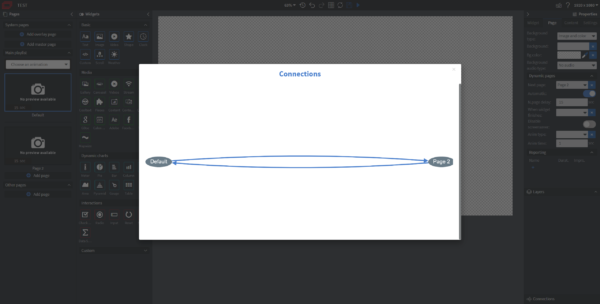
When a content has multiple pages, Connections appears at the bottom right of the canvas. Open it to see a chart of how pages connect and the order in which they play.

Blue arrows show time-based transitions; green arrows show transitions caused by interactive events.